What to Expect in .NET 11: Runtime, Performance, and Async Improvements
What to Expect in .NET 11?
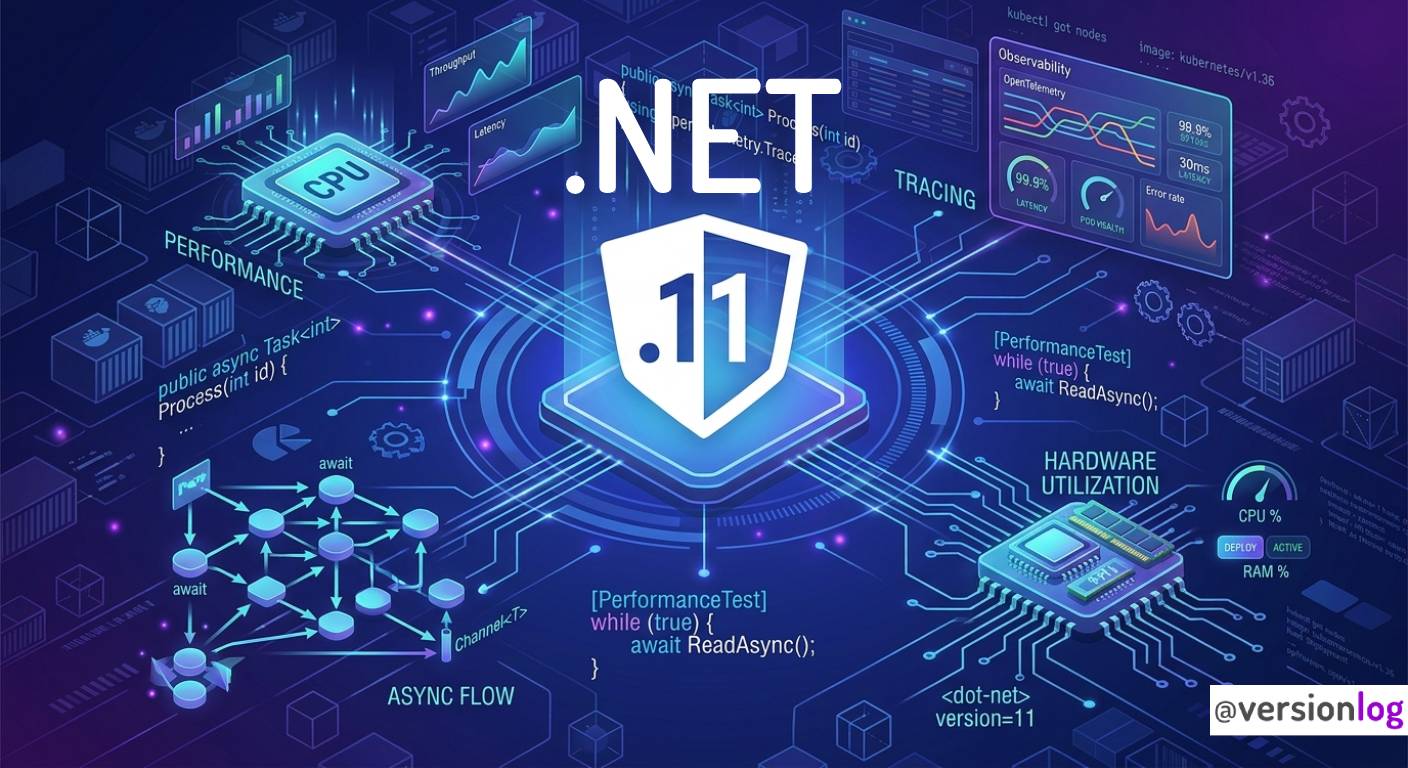
.NET 11 focuses on making the platform faster, more efficient, and easier to work with. The release brings runtime-level improvements to asynchronous code, better hardware utilization, new library APIs, and enhanced observability support for modern applications.
Developers will benefit from cleaner debugging, reduced overhead, and stronger performance on current generation processors.
How does .NET 11 improve asynchronous programming?
.NET 11 introduces runtime-native async support. By handling async suspension and resumption directly in the runtime, it produces much cleaner stack traces and reduces overhead compared to previous compiler-generated state machines.
This change is especially helpful when debugging complex async flows or running high-throughput services.
What runtime and hardware improvements are coming?
The runtime now requires modern instruction sets on both x86/x64 and Arm64 platforms. This allows the JIT compiler to apply more aggressive optimizations while reducing maintenance complexity.
Additional JIT enhancements include better bounds check elimination, removal of redundant checked contexts, and new intrinsics for Arm SVE2 to accelerate vectorized workloads.
What new library and API features are expected?
.NET 11 adds several useful APIs and performance improvements across core libraries:
- New Rune-based methods for more efficient string and character handling
- BFloat16 support in
BitConverterfor AI and machine learning scenarios - Generic type info retrieval support in
System.Text.Json - Improved
Matrix4x4.GetDeterminantperformance (around 15% faster) - New capabilities for Tar archive format selection and ZipArchiveEntry handling
How will ASP.NET Core observability improve in .NET 11?
ASP.NET Core now includes native OpenTelemetry tracing support. The framework automatically populates standard semantic attributes for HTTP requests, making distributed tracing simpler and more consistent without extra packages.
This brings better visibility into production applications with less manual instrumentation.
What other improvements are planned?
The SDK becomes smaller on Linux and macOS thanks to assembly deduplication. Several code analyzers have been improved to reduce noise and provide clearer messages. Cross-platform support continues to grow with better architecture enablement and WebAssembly improvements.
Key Improvements Expected in .NET 11
| Area | Improvement | Benefit |
|---|---|---|
| Runtime | Runtime-native async | Cleaner stack traces and lower overhead |
| Performance | Modern hardware baseline + JIT enhancements | Faster execution on current CPUs |
| Observability | Native OpenTelemetry tracing in ASP.NET Core | Simpler and more consistent telemetry |
| Libraries | BFloat16, Rune APIs, System.Text.Json generics | Better support for text, AI, and JSON workloads |
| SDK & Tooling | Smaller installers and improved analyzers | Faster setup and better code quality feedback |
How should you prepare for .NET 11?
Begin by testing your applications on the latest preview builds. Pay special attention to async-heavy code to benefit from cleaner debugging. Review any performance-critical sections and experiment with the new library APIs, particularly for JSON and numeric operations.
Most existing .NET 8 and .NET 9 applications are expected to upgrade smoothly.
Frequently Asked Questions
Will .NET 11 require many code changes?
No. The majority of applications should run with little or no modification. Most changes are additive or performance-oriented.
Is the runtime-native async a significant improvement?
Yes. It reduces overhead and provides much clearer call stacks when debugging async code, especially in complex services.
Should teams start testing .NET 11 now?
Absolutely. Early testing helps you take full advantage of the performance and observability improvements when the final release arrives.
Related Software Tracker


VersionLog Team
Editorial Team
Curating the latest software releases, changelogs, and framework comparisons for developers.